

Four-Post vs. Scissor Alignment Lifts: Which Is Better?
Four-post alignment lifts are versatile and double as everyday service lifts. Scissor alignment lifts keep the bay open with no columns. The right choice depends on your space, your workflow, and what else the bay needs to do.
In this guide
If you're setting up a dedicated alignment bay, the lift matters as much as the aligner. The two most common choices are a four-post alignment lift and a scissor alignment lift. Both get the job done. They just fit different shops.
What makes a lift an alignment lift
Any lift you align on needs a few things a standard lift doesn't have:
- Front turnplates so the front wheels can turn freely while you measure and adjust
- Rear slip plates so the rear wheels can move as you make adjustments
- A level surface so measurements are accurate
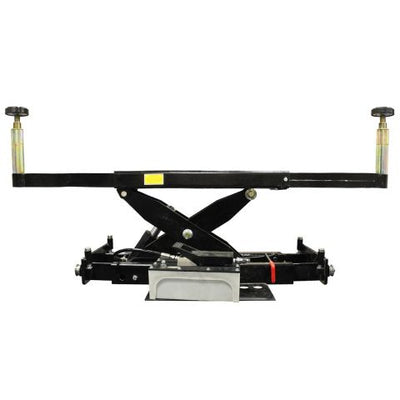
- A way to lift the wheels off the runways when you need to, usually with rolling jacks
Four-post alignment lifts
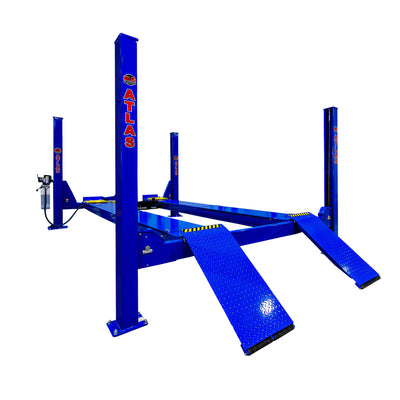
A four-post alignment lift is a drive-on lift with turnplates in the front of the runways and slip plates in the rear. You drive on, align, and drive off.
Why shops choose them:
- They double as a general service lift for inspections, exhaust and oil changes when you're not aligning
- Long runways handle everything from small cars to long-wheelbase trucks
- Add rolling jacks, like the Atlas RJ8000 or RJ8A, to lift the wheels for suspension work
The trade-off: four columns take up floor space, and you have to work around them.
Popular options include the Atlas 412A, the Atlas 414A, and the open-front Atlas PVL14OF-EXT.
Scissor alignment lifts
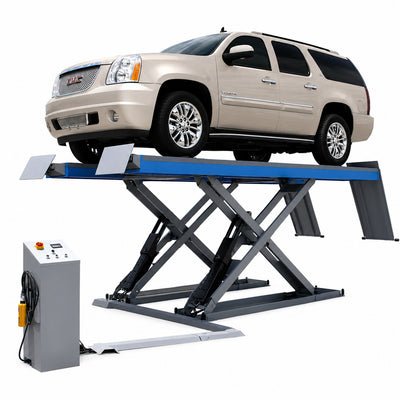
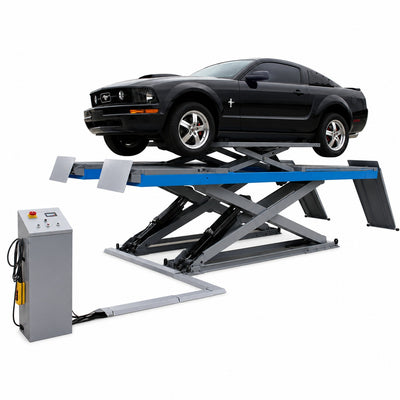
A scissor alignment lift raises two low-profile platforms with a scissor mechanism instead of columns.
Why shops choose them:
- No columns, so the bay stays open and easy to walk around
- A compact footprint that fits bays where a four-post feels cramped
- A clean, modern look in customer-facing shops and dealerships
The trade-off: scissor alignment lifts are more specialized, and you'll want rolling jacks to lift the wheels for adjustments.
Options include the Atlas 12ASL, the Atlas 12AWFSL, and the Bright Lambda 500. The Atlas RJ-6 rolling jack is made specifically for the 12ASL and 12AWFSL.
Side by side
| Four-post alignment lift | Scissor alignment lift | |
|---|---|---|
| Floor space | Larger, four columns | Compact, no columns |
| Doubles as a service lift | Yes, very versatile | More specialized |
| Lifting the wheels | Add rolling bridge jacks | Add rolling jacks |
| Best for | Shops that want one lift to do a bit of everything | Dedicated alignment bays and tight spaces |
Don't forget a third option
If you're not ready to dedicate a bay at all, a portable aligner can work on the lifts you already have. Read Can You Add Alignments to a Lift You Already Own?
Our take
If the bay needs to earn money doing more than alignments, go with a four-post. It's the more flexible choice for most independent shops. If you're building a dedicated alignment bay, have limited space, or want an open, clean look, a scissor alignment lift is hard to beat. Either way, check which jacks fit using our bridge jack fit chart.
Compare them side by side
Alignment lifts are big purchases, and it helps to stand next to one. At our showroom in Daleville, Indiana, four-post and scissor lifts are set up so you can see the footprint, the runways and the jacks in person.
Questions about your bay? Call us at 765-544-3838, or browse our alignment lifts.
Products in this guide




Related guides

Concrete Requirements for a Car Lift: How Thick Is Thick Enough?
Most 9,000 to 10,000 lb. two-post lifts need at least 4" of 3,000 PSI concrete. Heavier two-post lifts and commercial four-post lifts usu...

Do You Need a Bridge Jack for Your Four-Post Lift?
If you want to do tire, brake or suspension work on a four-post lift, yes. A bridge jack lifts the wheels off the runways so they hang fr...

Is an Alignment Machine Worth It? The Payback Math
For most shops, yes. At just two alignments a day, a $19,995 aligner can pay for itself in about five months. Here's how to run the numbe...
See it in person
Measure, compare, and watch the equipment run at our showroom in Daleville, Indiana.