

Do You Need a Bridge Jack for Your Four-Post Lift?
If you want to do tire, brake or suspension work on a four-post lift, yes. A bridge jack lifts the wheels off the runways so they hang free. If you mainly use your four-post for storage, you can skip it.
In this guide
A four-post lift holds the vehicle up by its tires, which is great for oil changes, exhaust work and storage. But it leaves the wheels sitting on the runways, so you can't pull a wheel or let the suspension hang. That's where a bridge jack comes in.
What a bridge jack does
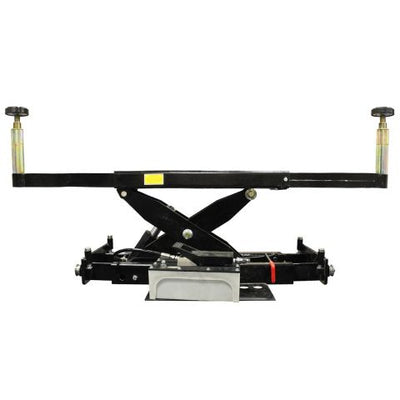
A bridge jack sits on or between the runways of a four-post lift. Slide it under the vehicle, raise it to the lifting points, and it lifts one end of the vehicle off the runways. Now the wheels hang free, and you can do tire, brake and suspension work without moving the vehicle to another lift.
Do you need one?
You probably do if you:
- Rotate tires or change wheels on the lift
- Do brake jobs
- Work on suspension, steering or wheel bearings
- Want one lift that can handle almost any job
You can probably skip it if you:
- Use the four-post mainly to store a second vehicle
- Mostly do oil changes, exhaust and underbody inspections
Sliding or rolling?
Sliding jacks ride on top of the runways and fit most hobbyist four-post lifts. Rolling jacks run on tracks between the runways, so your lift needs those tracks. Lifts like the Atlas Garage PRO9000 and most commercial four-posts have them.
Manual or air?
Manual jacks use a hydraulic hand pump, so you don't need an air compressor. That's a big plus in a home garage. Air/hydraulic jacks run on shop air and lift faster with less effort, which adds up in a busy shop.
How much capacity?
A bridge jack lifts one end of the vehicle at a time, so it doesn't need to lift the whole vehicle. Choose a jack rated for the heaviest axle you plan to lift. Our jacks range from 3,500 to 8,000 lbs.
The most important part: fit
Not every jack fits every lift. Runway spacing, track design and lift brand all matter. The easiest way to check is our bridge jack fit chart, which lists every four-post lift we carry and the jacks that fit it. You can filter it by brand, too.
A few examples:
- The Atlas 3,500 lb. sliding bridge jack fits the Atlas Garage PRO8000 lifts and the Bright Kappa 8S and 8H
- The Atlas RJ8000 and RJ8A fit the Atlas 412, 412A, 414, 414A and Pro14KCF-EXT
- The Atlas RJ-6 is made for the 12ASL and 12AWFSL alignment scissor lifts
Our take
If you're buying a four-post to work on vehicles, not just store them, plan on a bridge jack from the start. It turns the lift into a true do-everything service lift. Many shops buy two, one for each end, so they can get all four wheels off the runways at once.
Not sure what fits your lift?
Check the jack fit chart, or call us at 765-723-6523 with your lift's make and model and we'll tell you exactly which jack fits. You can also see four-post lifts with bridge jacks set up in our Daleville, Indiana showroom.
Browse all four-post bridge jacks, or read Two-Post vs. Four-Post Lift: Which Is Right for You?
Products in this guide



Related guides

Concrete Requirements for a Car Lift: How Thick Is Thick Enough?
Most 9,000 to 10,000 lb. two-post lifts need at least 4" of 3,000 PSI concrete. Heavier two-post lifts and commercial four-post lifts usu...

Sandblast vs. Spray Wash Cabinets: Which Do You Need?
A sandblast cabinet strips rust, paint and corrosion down to bare metal. A spray wash cabinet washes away grease and grime with hot, soap...

What Size Air Compressor Do You Need?
Size a compressor by CFM, not horsepower or tank size. Add up the air your tools use, add a cushion, and match it to a compressor that de...
See it in person
Measure, compare, and watch the equipment run at our showroom in Daleville, Indiana.