

Two-Post vs. Four-Post Lift: Which Is Right for You?
Buying a lift to work on cars? Go with a two-post, which leaves the wheels free for brakes and suspension. Buying one to park a second car? Go with a four-post, which you simply drive onto.
In this guide
This is the first decision every lift buyer makes, and it's simpler than it looks. It mostly comes down to one question: are you buying a lift to work on cars or to store them?
The short version
| Two-post lift | Four-post lift | |
|---|---|---|
| Best for | Repair and service work | Parking a second car, oil changes, exhaust |
| Wheels | Hang free, ready to come off | Sit on the runways (add a bridge jack to lift them) |
| Getting the car on | Position four arms under the lift points | Drive on and go |
| Installation | Anchored to concrete | Many hobby models are freestanding |
| Can you move it? | No, it's bolted down | Often yes, with a caster kit |
| Floor space | Smaller footprint, open floor between posts | Larger footprint, runways take up the bay |
When a two-post lift makes sense
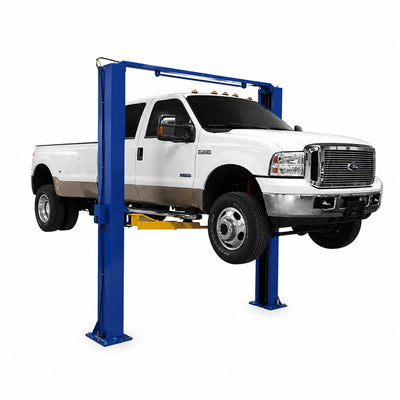
If you're going to be pulling wheels, doing brakes, working on suspension, or swapping exhausts and transmissions, a two-post lift is the better tool. The vehicle is held by its frame or pinch welds, so the wheels and suspension hang free and you can walk all the way around it.
A few things to know before you buy:
- It has to be anchored. Most two-post lifts need at least 4" of 3,000 PSI concrete, and heavier lifts need more.
- Ceiling height matters. Overhead models need about 11' 6" to 12' 3". Baseplate models fit under about 9' 4". Our ceiling height guide walks through the math.
- You'll set the arms for each vehicle. It only takes a minute once you know your vehicle's lift points, but it's an extra step compared to driving on.
For most home garages, a 9,000 lb. lift like the Atlas 9KOHX handles cars, SUVs, and half-ton pickups. If you work on heavier trucks, the 10,000 lb. Atlas PV10PX is a step up.
When a four-post lift makes sense
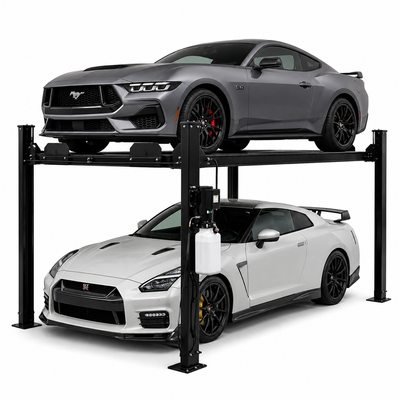
If your main goal is fitting two cars in the space of one, a four-post lift is hard to beat. You drive onto the runways, raise it, and park another vehicle underneath. There are no arms to set and nothing to line up under the car.
- Many are freestanding. Hobby four-posts like the Atlas Garage PRO8000 don't need to be anchored, so they can go in garages where a two-post can't.
- Some can roll. With a caster kit, you can move the lift around your garage or take it with you if you move. The Atlas Garage PRO9000 includes one.
- Great for fluid work. Oil changes, exhaust, and inspections are easy with the vehicle sitting on its wheels.
The trade-off is wheel work. With the vehicle resting on its tires, you can't pull wheels or do brakes until you lift the axle off the runways. That's what a bridge jack is for: it rides on the lift and raises one end of the vehicle so the wheels hang free.
Ask yourself these four questions
- Is this mainly for storage or for repairs? Storage points to a four-post. Repairs point to a two-post.
- How often will the wheels come off? If it's often, a two-post saves time on every job.
- Can you anchor into your floor? If your concrete is thin, cracked, or you're renting, a freestanding four-post avoids the issue.
- Will you ever move it? A four-post with casters can go with you. A two-post stays put.
Our take
If you're mostly parking a second car and doing the occasional oil change, go with a four-post. If you'll be turning wrenches on brakes, suspension, and drivetrains, go with a two-post. And if you want both, plenty of our customers start with a four-post and add a bridge jack later, or put a two-post in one bay and a four-post in the other.
See them side by side
Pictures only tell you so much. In our Daleville, Indiana showroom, two-post and four-post lifts are set up next to each other, so you can see the footprint of each, watch them run, and get a real feel for which one fits the way you work. Most lift sellers can't offer that because they ship from a warehouse. We built a showroom so you can see the equipment before you buy.
Ready to narrow it down? Try the two-post lift finder or the four-post lift finder, or call us at 765-544-3838 and tell us what you're working on.
Products in this guide


Related guides

Concrete Requirements for a Car Lift: How Thick Is Thick Enough?
Most 9,000 to 10,000 lb. two-post lifts need at least 4" of 3,000 PSI concrete. Heavier two-post lifts and commercial four-post lifts usu...

Do You Need a Bridge Jack for Your Four-Post Lift?
If you want to do tire, brake or suspension work on a four-post lift, yes. A bridge jack lifts the wheels off the runways so they hang fr...

Four-Post vs. Scissor Alignment Lifts: Which Is Better?
Four-post alignment lifts are versatile and double as everyday service lifts. Scissor alignment lifts keep the bay open with no columns. ...
See it in person
Measure, compare, and watch the equipment run at our showroom in Daleville, Indiana.