

Learning Center›Shop Equipment
What Size Air Compressor Do You Need?
Size a compressor by CFM, not horsepower or tank size. Add up the air your tools use, add a cushion, and match it to a compressor that delivers that much air at the pressure you need.
In this guide
Most compressor shopping starts with horsepower and tank size. Those matter, but the number that tells you whether your tools will actually keep up is CFM, the volume of air the compressor delivers at a given pressure.
CFM is the number that matters
Every air tool needs a certain amount of air, measured in CFM (cubic feet per minute) at a certain pressure, usually 90 PSI. If your compressor can't deliver at least that much, the tool slows down, the compressor runs nonstop, and you end up waiting on it.
When you compare compressors, look for delivered CFM at 90 PSI. It's the most useful apples-to-apples number for automotive tools.
How much air common tools use
These are typical ranges. Always check the rating on your own tools.
| Tool | Typical air use |
|---|---|
| Tire inflation, blow guns | Low, short bursts |
| Air ratchet | About 3 to 5 CFM |
| 1/2" impact wrench | About 4 to 6 CFM |
| Die grinder, cut-off tool | About 4 to 7 CFM |
| Paint spray gun | About 6 to 12 CFM |
| Dual-action sander | About 10 to 13 CFM, used continuously |
| Sandblast cabinet | About 15 to 24 CFM, used continuously |
The tools that run continuously, like sanders and blast cabinets, are the ones that size your compressor. An impact wrench used in short bursts is much easier to keep up with.
A simple way to size it
- Find your hungriest tool, or add up the tools that will run at the same time
- Add a 25 to 50 percent cushion so the compressor isn't running at its limit all day
- Plan for growth. If you'll add a tech or a blast cabinet next year, size for it now
Tank size, single-stage and two-stage
Tank size is a reserve, not extra power. A bigger tank lets the compressor rest between cycles and smooths out bursts of demand, but it doesn't raise the CFM.
Two-stage compressors compress the air twice, reaching higher pressures (up to 175 PSI) more efficiently. They're built for steady, all-day shop use. Single-stage models are simpler and a great fit for lighter use.
Don't forget the electrical
A small compressor like the Atlas AF2 plugs into a standard 110V outlet. Shop compressors need 220V: most 5 HP models call for a 30 amp breaker and #10 wire, and 7.5 HP models call for a 40 amp breaker and #8 wire. If you don't have power where you need air, a gas-powered compressor is the answer. For more on power, read 110V vs. 220V: Power Requirements for Shop Equipment.
Matching a compressor to your shop
| Your setup | Good fit | Delivered air |
|---|---|---|
| Home garage, tires, light air tools | AF2 (2 HP, 20 gal, 110V) | 6.0 CFM @ 90 PSI |
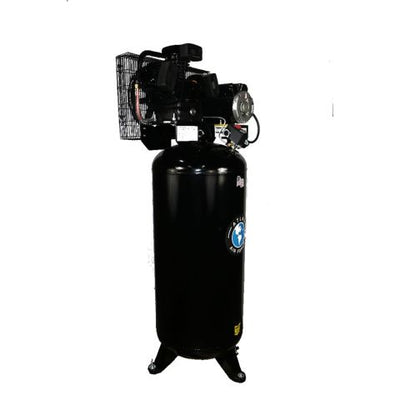
| Serious home garage or one-bay shop | AF5 (5 HP, 60 gal) | 18 CFM @ 90 PSI |
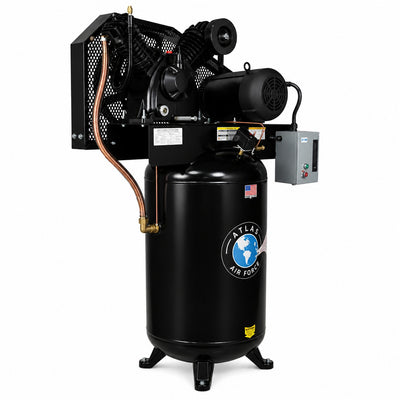
| Busy shop, all-day use | AF6, AF8 (5 HP, 80 gal, two-stage) | 18.5 to 20 CFM @ 145 PSI |
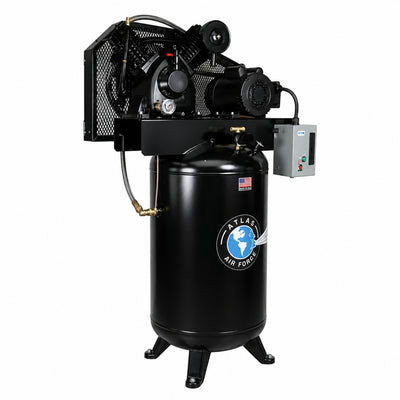
| Multiple techs, blasting, painting | AF9 (7.5 HP, 80 or 120 gal) | 23 CFM @ 90 PSI |
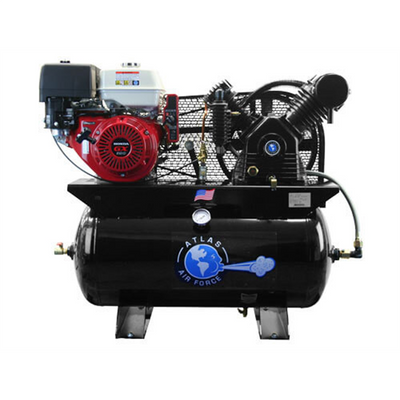
| No power on site, mobile service | AF13, AF14 gas | 25 CFM @ 90 PSI |
Plus Package models like the AF8P add an automatic low oil monitor, automatic tank drain and an aftercooler, which are worth it for compressors that run all day.
Our take
Buy more compressor than you think you need. An undersized compressor is the most common regret we hear, because it slows down every air tool in the shop. For a home garage, the AF2 handles tires and light tools. For any working shop, start with a 5 HP, 80 gallon two-stage, and step up to 7.5 HP if you'll run a blast cabinet, paint or more than a couple of techs at once.
Hear them run
Our showroom in Daleville, Indiana has a full row of compressors on display, from portable to 7.5 HP. Stop by to compare sizes in person, or call us at 765-544-3838 and tell us which tools you run.
Ready to shop? Browse all air compressors.
Products in this guide




Related guides

Do You Need a Bridge Jack for Your Four-Post Lift?
If you want to do tire, brake or suspension work on a four-post lift, yes. A bridge jack lifts the wheels off the runways so they hang fr...

Sandblast vs. Spray Wash Cabinets: Which Do You Need?
A sandblast cabinet strips rust, paint and corrosion down to bare metal. A spray wash cabinet washes away grease and grime with hot, soap...
See it in person
Measure, compare, and watch the equipment run at our showroom in Daleville, Indiana.