

Learning Center›Buying & Installation
110V vs. 220V: Power Requirements for Shop Equipment
Most two-post lifts, shop compressors and heavy machines need 220V. Many garage four-post lifts, storage lifts and smaller tire machines run on standard 110V. Check before you buy so your equipment is ready to run the day it arrives.
In this guide
It's one of the most common surprises when new equipment arrives: the plug doesn't match the outlet. Checking power requirements before you buy saves you from a lift sitting in the crate while you wait for an electrician.
110V vs. 220V, in plain terms
110V (also called 115V or 120V) is the standard household outlet. 220V (also called 208V or 230V) is the higher-voltage circuit used for dryers, ranges and most shop equipment. Equipment designed for 220V can't run on a standard outlet, and plugging 110V equipment into 220V can damage it.
Single phase vs. three phase
Homes and most small shops have single-phase power. Larger commercial buildings often have three-phase power, which runs big motors more efficiently. Most equipment we sell runs on single phase, and some models, like certain Forward Lift lifts and the Atlas AF10 compressor, are available in a three-phase version. If you're not sure what your building has, an electrician can tell you in minutes.
What our equipment needs
| Equipment | Typical power |
|---|---|
| Most two-post lifts | 220V single phase, 30 amp breaker recommended |
| Commercial four-post lifts | 220V single phase, 30 amp breaker |
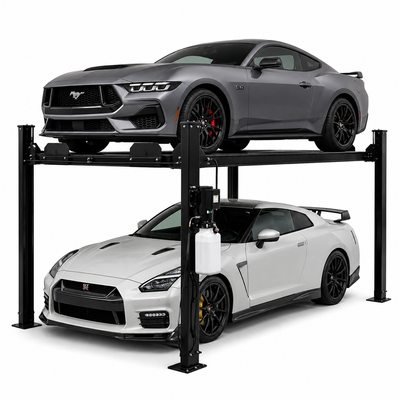
| Garage four-post lifts like the Atlas Garage PRO8000 and PRO9000 | 110V, 30 amp breaker required |
| Direct Lift Pro Park four-post lifts | 115V |
| Powerline storage lifts | Standard 110V outlet (lifts twice as fast on 220V) |
| Car and light truck tire changers and balancers | Many run on 110V; check each product |
| Truck tire changers like the Bright LC557 | 220V single phase, no plug included |
| Shop air compressors (5 HP) | 220V, 30 amp breaker, #10 wire |
| Shop air compressors (7.5 HP) | 220V, 40 amp breaker, #8 wire |
| Spray wash cabinets | 220V single phase, 30 amp breaker |
The exact requirement is in the specs on every product page. Go by that for the model you're buying.
Don't forget air
Many lifts also need compressed air. Commercial four-post lifts like the Atlas 412 and 414 use air-operated locks and need an outside air supply of about 85 to 115 PSI. Air/hydraulic bridge jacks and most tire changers need shop air too. If you don't have a compressor yet, read What Size Air Compressor Do You Need?
Tips before your equipment arrives
- Check the plug situation. Some equipment ships without a plug and needs to be wired by an electrician.
- Plan the location. Put the outlet where the power unit or machine will actually sit.
- Use the right breaker and wire size. Undersized wiring can trip breakers or overheat.
- Hire a licensed electrician for any new 220V circuit. It's usually a quick job and keeps everything up to code.
Our take
Before you order, write down what power you have where the equipment will go. If you're setting up a home garage, a 110V four-post like the Atlas Garage PRO8000 or a Direct Lift Pro Park can save you from running a new circuit. For a working shop, plan on 220V for lifts, compressors and heavy machines, and have your electrician set it up before delivery day.
Not sure what you need?
Call us at 765-544-3838 and tell us what power you have available. We'll point you to equipment that fits, or tell you exactly what to ask your electrician for.
Also see Concrete Requirements for a Car Lift.
Products in this guide


Related guides

How Equipment Financing Works
Equipment financing lets you get lifts, tire machines, alignment and complete packages working now and pay over 24 to 72 months. Our best...

What to Expect When Your Equipment Ships
Lifts and shop equipment ship by freight on crates and pallets that can weigh over a ton. Plan for a forklift or other unloading equipmen...

Concrete Requirements for a Car Lift: How Thick Is Thick Enough?
Most 9,000 to 10,000 lb. two-post lifts need at least 4" of 3,000 PSI concrete. Heavier two-post lifts and commercial four-post lifts usu...
See it in person
Measure, compare, and watch the equipment run at our showroom in Daleville, Indiana.