

Rim-Clamp vs. Center-Post Tire Changers
Rim-clamp tire changers grip the wheel with jaws and are fast, versatile and affordable. Center-post tire changers lock the wheel through its center and never touch the rim edge, which protects expensive and oversized wheels.
In this guide
Every tire changer has to hold the wheel steady while you work. How it holds the wheel is the biggest difference between machines, and it matters most when you're working on expensive or oversized wheels.
Rim-clamp tire changers
A rim-clamp machine has a turntable with four jaws that grip the wheel, either from the outside edge of the rim or from the inside. It's the most common design, and most Atlas and Bright tire changers work this way.
Why shops choose them:
- Fast to load and clamp, which matters when you're doing a lot of tires
- Handle a wide range of wheel sizes with inside and outside clamping
- Available at every price point, from home garage machines to high-volume shop machines
The trade-off: the jaws touch the rim. On expensive alloy and custom wheels, techs use jaw protectors to avoid marks.
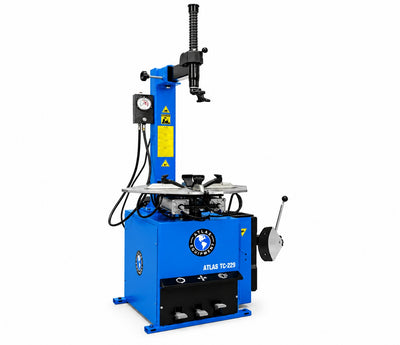
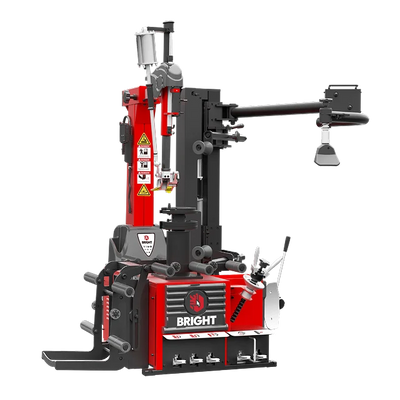
Rim-clamp machines come in two styles. Swing-arm machines, like the Atlas TC229, swing the tool arm out of the way. Tilt-back machines, like the Atlas TC755 and Bright GT890N, tilt the column back, which is faster when you're doing the same size wheel over and over.
Center-post tire changers
A center-post machine locks the wheel through its center bore onto a post, instead of gripping the rim edge. Nothing clamps onto the outside of the wheel.
Why shops choose them:
- No contact with the rim edge, which protects expensive alloy, custom and large-diameter wheels
- Steady, secure hold on big, heavy wheel and tire assemblies
- Built for tough low-profile and run-flat tires
The trade-off: center-post machines cost more, and they're more machine than many home garages need.
Options include the Bright 897, which handles 12" to 30" rims with no rim contact, and the Atlas PTC400, which adds a left-hand assist arm.
Side by side
| Rim-clamp | Center-post | |
|---|---|---|
| How it holds the wheel | Jaws grip the rim | Locks through the center bore |
| Rim contact | Yes, use jaw protectors on nice wheels | No contact with the rim edge |
| Speed | Very fast to load | Slightly more setup per wheel |
| Price | Every budget | Higher |
| Best for | Most shops and home garages | High-end, large and low-profile wheels |
Our take
For most shops and every home garage, a quality rim-clamp machine is the right choice. Add an assist arm if you see a lot of low-profile tires. If your business is built on expensive wheels, performance cars or big custom setups, a center-post machine like the Bright 897 protects the wheels your customers care most about. For more on assist arms, read Do You Need an Assist Arm on Your Tire Changer?
Try them side by side
At our showroom in Daleville, Indiana, rim-clamp, tilt-back and center-post machines are set up next to each other. Bring a wheel, and we'll show you how each one handles it.
Use the tire changer finder, or call us at 765-544-3838.
Products in this guide


Related guides

Choosing a Tire Changer for a Home Garage
For a home garage, choose a 110V rim-clamp tire changer that fits your largest wheels, make sure you have an air compressor to run it, an...

Car vs. Truck Tire Changers: When Do You Need Heavy-Duty?
Car and light truck tire changers handle passenger tires up to about 49". For semi, bus, ag and fleet tires, you need a heavy-duty truck ...

Do You Need an Assist Arm on Your Tire Changer?
If you regularly change low-profile, run-flat, or stiff light truck tires, yes. If you mostly change standard tires on steel or factory w...
See it in person
Measure, compare, and watch the equipment run at our showroom in Daleville, Indiana.